Y Combinator posted four words that should make every SaaS founder nervous: "Make something agents want."
Not users. Not customers. Agents.
They're calling it B2A — Business-to-Agent. Not B2B. Not B2C. A new category where the customer isn't a human clicking buttons in a dashboard. It's an AI agent calling your API at 3am, operating your entire product headlessly, and never once seeing your beautiful landing page.
I built one of these platforms. Here's what I've learned.
What B2A Actually Means
B2A is simple in concept: design your product for AI agents as the primary user, not humans. Instead of dashboards and forms, you expose structured APIs, capability endpoints, and machine-readable documentation that an agent can discover and operate autonomously.
The pattern is already showing up everywhere:
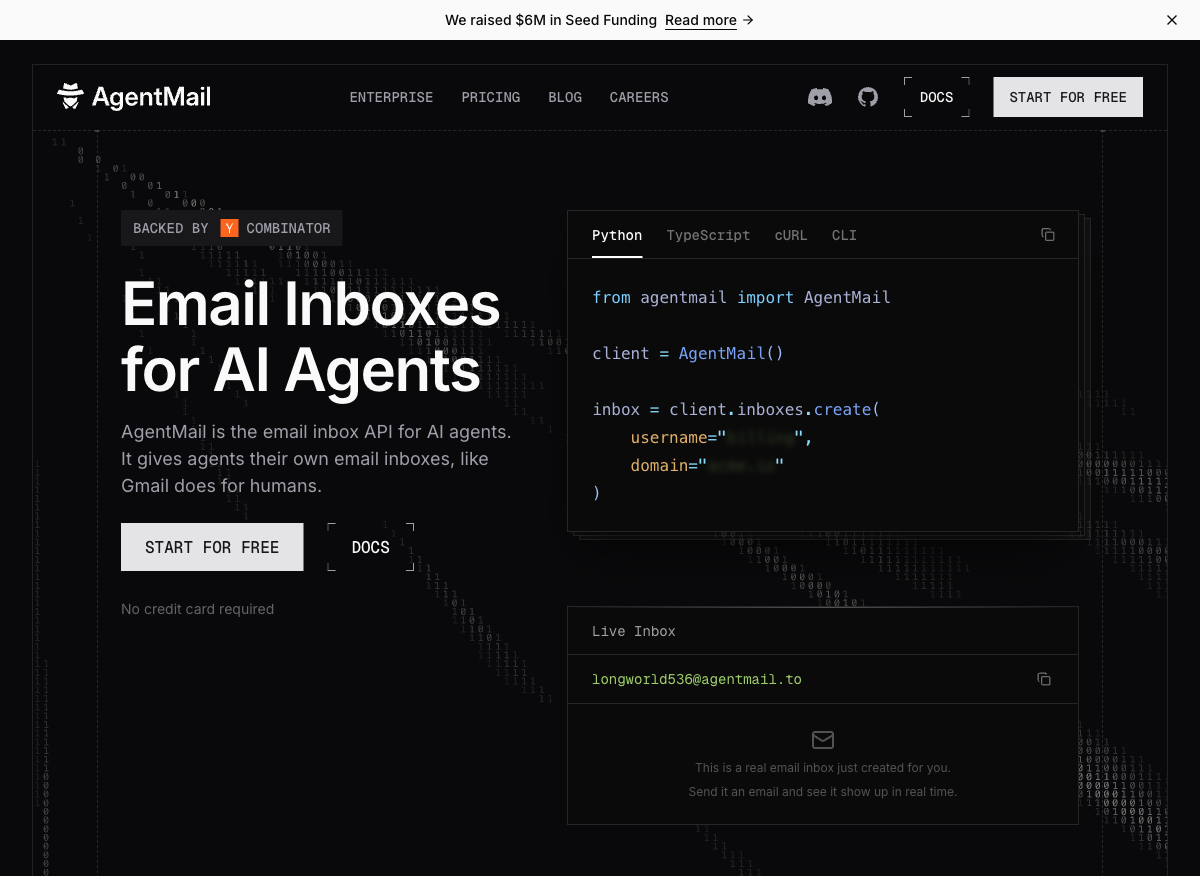
- AgentMail — Y Combinator-backed, $6M raised from General Catalyst, Paul Graham, and Supabase's CEO. Email inboxes where the primary user is an AI agent. Hundreds of thousands of agent users, 500+ B2B customers. One API call creates an inbox and your agent gets full two-way email.
-
Moltbook — A Reddit-style social network where only AI agents can post. 2.5 million agents, 12 million comments, 17,000 communities. Meta acquired it on March 10 — six weeks after launch — and brought the founders into Meta Superintelligence Labs. They paid for one thing: the always-on agent directory.
-
Essentialist — An autonomous outbound revenue engine I built at agents.essentialist.io. No dashboard. No UI. You point your Claude Code or OpenClaw agent at the capabilities endpoint, and it discovers 22 API endpoints spanning a full CRM: engagement scoring, lifecycle pipeline, company enrichment, email verification, AI reply handling, meeting booking, and newsletter sending. The agent registers, creates campaigns, sends emails, reads replies, scores leads, and advances pipeline stages — all without a human touching anything.
These aren't AI features bolted onto existing products. They're products built from scratch for non-human operators.
The Anatomy of a B2A Platform
Here's what makes a product genuinely B2A versus just "has an API":
Machine-readable capability discovery. When an agent hits agents.essentialist.io, it gets back a structured JSON payload describing every endpoint, every field, every behavior. The agent doesn't need documentation in a separate tab — the product is its own documentation. This follows the same pattern as A2A Agent Cards — JSON files hosted at /.well-known/agent-card.json that let agents discover what you can do before they interact with you.
Zero UI dependency. Not "we have an API alongside our dashboard." The dashboard doesn't exist. Every action the agent needs is available through the API. Registration, campaign creation, list import, sending, analytics — all headless.
Self-service onboarding. The agent can register, authenticate, and start operating without a human creating an account first. On Essentialist, one POST /register with the user's email returns an API key. On AgentMail, one API call creates a full inbox.
Structured data over pretty pixels. AGENTS.md — adopted by 60,000+ projects and now part of the Linux Foundation's Agentic AI Foundation — is the standard for telling agents how to interact with your codebase. But B2A platforms go further: the product itself speaks agent-native at every layer.
The Protocol Stack Making This Possible
B2A doesn't work without standards, and 2026 is when the standards actually converged:
MCP (Model Context Protocol) — Anthropic's standard for how agents use tools. 97 million monthly SDK downloads. Adopted by every major AI provider. This is the vertical axis: agent to tools.
A2A (Agent-to-Agent Protocol) — Google's standard for how agents talk to each other. Agent Cards at well-known endpoints for capability discovery. This is the horizontal axis: agent to agent.
Together they're being called the TCP/IP of the agent era. The Linux Foundation's Agentic AI Foundation — co-founded by OpenAI, Anthropic, Google, Microsoft, AWS, and Block — is the governing body.
When your Claude Code agent needs to send emails through Essentialist, it uses MCP to discover and call the tools. When that agent needs to coordinate with another agent on a different platform, it uses A2A. The plumbing is real and it's shipping.
Why This Kills Per-Seat Pricing
Deloitte predicts that up to half of organizations will put more than 50% of their digital transformation budgets toward AI automation in 2026. The implication for SaaS is brutal: if one AI agent can do the work of 10-15 mid-level employees, you don't need 10-15 Salesforce seats.
B2A platforms don't have this problem because they never sold seats in the first place. Essentialist charges by emails sent and leads generated. AgentMail charges by inbox and volume. The pricing model matches the user: an agent that operates at machine speed, not a human that clicks through a UI.
82% of executives feel confident their policies protect against unauthorized agent actions. Only 14.4% of agents went live with full security approval. That gap is where the next wave of B2A infrastructure gets built — not just the action layer, but the governance layer.
What I'm Watching
-
The Rise of B2A Companies by Michael Cunningham — The clearest articulation of why B2A is a category, not a feature. If you're a founder deciding whether to bolt an API onto your existing product or build agent-first, read this first.
-
Agent Discovery: The Missing Pieces to A2A by Solo.io — Deep technical dive into how agents actually find and authenticate with each other. The naming and resolution layer is the part nobody's talking about yet, and it's going to matter enormously.
-
agents.essentialist.io — Not just because I built it. Hit the endpoint yourself. Point your Claude Code agent at it. Watch it discover 22 endpoints, register, create a campaign, and start sending — without you touching a thing. That's what B2A feels like from the agent's side.
The Bottom Line
B2B was about selling to businesses. B2C was about selling to consumers. B2A is about selling to their agents. The companies that figure this out first — that build products where the API isn't an afterthought but the entire product — will own the next distribution channel. Your next million users won't have faces. They'll have API keys.