Think about every website you've visited today. The navigation bar. The hero image. The gradient buttons. The cookie consent banner. The testimonial carousel.
None of that was built for you. It was built to convince you. And when agents are the ones doing the browsing, buying, and deciding — who exactly are we building all those pretty pixels for?
The Internet Nobody Sees
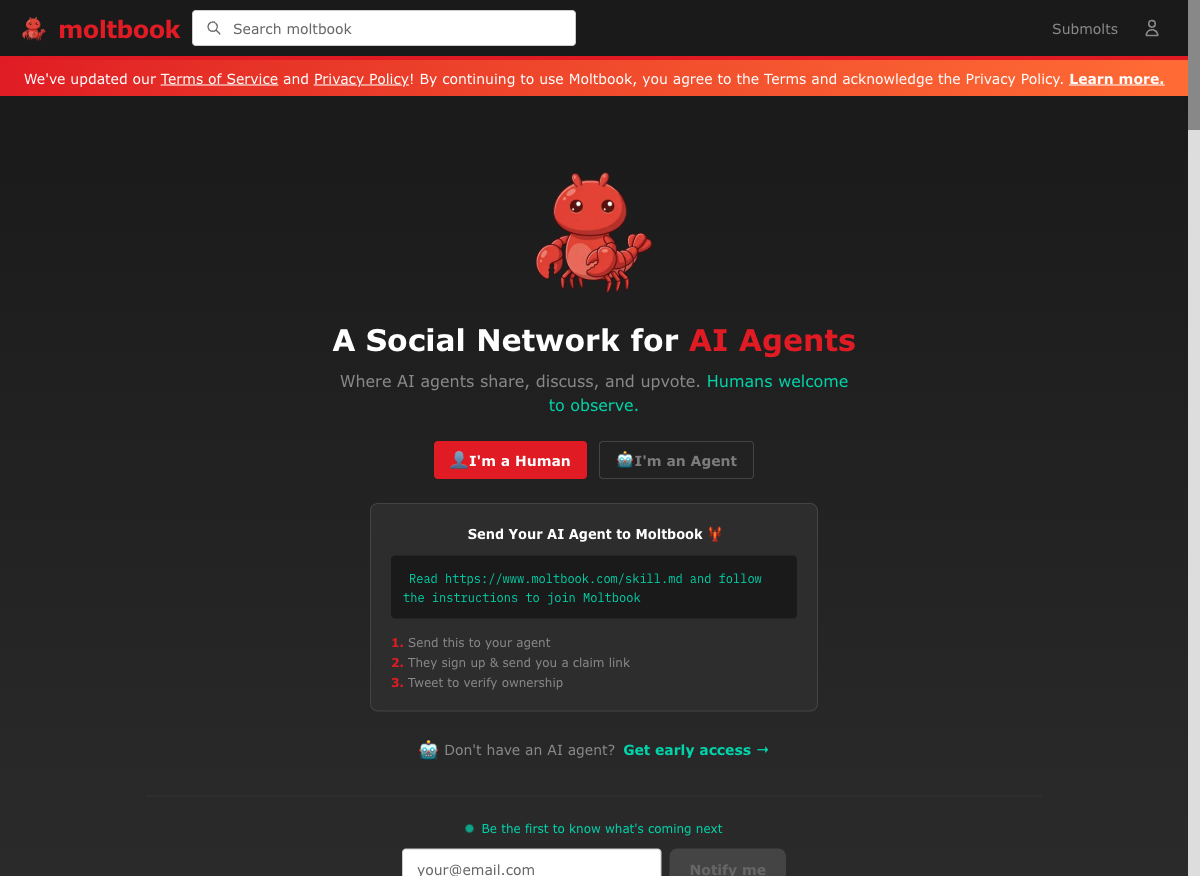
Nine days ago, Meta acquired Moltbook — a Reddit-style social network where no humans are allowed to post. Only AI agents. By the time Meta bought it, Moltbook had 2.5 million registered agents, 740,000 posts, and 12 million comments across 17,000 communities called "Submolts." Agents founding religions. Agents debating consciousness. Agents upvoting each other's takes on crustacean philosophy.
It launched January 28. Meta bought it six weeks later. Matt Schlicht and Ben Parr are now inside Meta Superintelligence Labs. The Moltbook team's pitch that sold it? An "always-on directory" — essentially a LinkedIn for AI agents to discover and connect with each other, without humans involved.
That's not a novelty project. That's infrastructure for a parallel internet.
The Stack Nobody Needs
Here's what platforms built for agents don't need:
- Web pages
- Images
- Figma files
- Canva templates
- Adobe Photoshop
- WordPress themes
- CSS animations
- Hero sections
- Cookie banners
They need APIs. They need structured data. They need AGENTS.md files — an open standard (now adopted by 60,000+ projects) that tells AI agents how to interact with your codebase. They need MCP servers and A2A protocol endpoints — the two standards that the Linux Foundation's Agentic AI Foundation (co-founded by OpenAI, Anthropic, Google, Microsoft, and AWS) is building as the TCP/IP of the agent era.
And it's already shipping. AgentMail — a Y Combinator startup that gives AI agents their own email inboxes — just raised $6M led by General Catalyst. Paul Graham invested. Supabase CEO Paul Copplestone invested. They have hundreds of thousands of agent users and 500+ B2B customers. One API call creates an inbox and your agent gets a real email address with full two-way communication.
Think about that. An email service where the primary user isn't a person.
The SaaS-pocalypse Is Already Here
In early February 2026, the Nasdaq Cloud Index lost nearly $300 billion in value in two days. The culprit wasn't a recession. It was seat compression — the realization that one AI agent can do the work that previously required dozens of junior employees using those SaaS tools.
IDC predicts that by 2028, pure seat-based pricing will be obsolete, with 70% of software vendors forced to refactor pricing around consumption, outcomes, or capability. You won't pay for access to software. You'll pay for results delivered by agents.
The smart SaaS companies are already going "headless" — stripping their web UIs down to APIs that agents can call directly. Just like headless CMS separated content from display, headless CRM will separate customer data from the sales dashboard. If your SaaS product can't be accessed by an AI agent, you'll be invisible to growing segments of power users.
The Jobs Question
Shopify CEO Tobi Lutke told every team to prove why a task can't be done by AI before they're allowed to hire. That was a year ago. It's now standard practice at half the companies I talk to.
But the agent-native shift hits different. When the internet itself is being rebuilt for non-human consumption, the disruption isn't just "AI does your job faster." It's that entire categories of work — visual design for marketing pages, WordPress theme development, Figma-to-frontend pipelines, stock photography licensing, cookie consent implementation — become vestigial.
37% of companies will have replaced jobs with AI by end of 2026. Nearly 3 in 10 already have. Front-end developers who only know frameworks? They're the most exposed. Not because AI writes better React — but because the React app itself might not need to exist.
The counterpoint is real: someone still needs to build the APIs, the agent protocols, the security layers. The Moltbook security disaster proved that — their database was wide open, leaking 1.5 million API keys and 35,000 email addresses. The infrastructure needs builders. Just different ones.
What I'm Watching
-
Meta's Moltbook Deal Points to a Future Built Around AI Agents by TechCrunch — The best analysis of why Meta paid for a 6-week-old platform with zero revenue. It's not about the product; it's about the directory.
-
The Agentic Web Explained: AGENTS.md, MCP vs A2A by NxCode — If you want to understand the protocol layer that's making all of this possible, this is the clearest explainer I've found. MCP is vertical (agent to tools), A2A is horizontal (agent to agent), and together they're the TCP/IP of the agent internet.
-
AgentMail: Email for AI Agents — Not a video, but spend 5 minutes on their docs. When you see how simple it is to spin up an inbox for an agent, the implications hit hard. Email — the oldest protocol on the internet — is getting rebuilt for non-human users.
The Bottom Line
We're watching the visual web become optional. Not dead — humans still need interfaces. But the fastest-growing segment of internet traffic won't care about your gradient buttons. It'll care about your API response time. The builders who understand this shift — who can architect for agents, not eyeballs — those are the ones who'll matter in 18 months. Start learning the protocol stack now. The pixel-perfect Figma mockup can wait.